
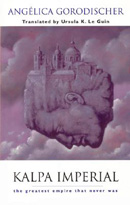
Small Beer Press, paperback, 9781931520058
Kalpa Imperial, the first book I have read by the eminent Argentine writer Angélica Gorodischer, is a fantasy—or, as the final story implies, perhaps a science fiction novel—set in an imagined empire with a lengthy history. But if the thought of another cookie-cutter epic fantasy fills you with dread, or if, on the other hand, you are allergic to the Latin American magic realism of authors such as Isabel Allende or Gabriel García Márquez, have no fear. Kalpa Imperial is neither.
Instead, it stands in the distinguished tradition of fabulation of authors such as Jorge Luis Borges and Italo Calvino, and it is arguably not a novel at all, but a collection of linked stories. As translated by Ursula K. Le Guin from the 1983 original, it reminded me most of a humanist equivalent of Gene Wolfe's science fiction series The Book Of The New Sun.
For a book about an empire—or a succession of empires, one founded on the ruins of another—and the ascension of emperors and empresses, Kalpa Imperial has a strong focus on the transitoriness of glory and the emptiness of ambition. The protagonists of these stories are often ordinary people, seemingly unmarked for greatness, who by accident or design back their way onto the throne, where they become affected in lesser or greater degree by the temptations and corruptions of power.
There is no story—or should that be chapter?—in Kalpa Imperial that I did not enjoy, but the highlights for me included the short and ironic "Siege, Battle and Victory of Selimmagud", the lengthy (and, yes, ironic) "Concerning the Unchecked Growth of Cities", and, probably the highlight for me, the penultimate story in the book, "'Down There in the South'".
The Empire of this book is in the North, a North of plains and deserts, mountains and seaports. A theme running through many of the stories is the difficulty of subduing the rebellious South, the land of heat and jungle, the land of the indigenes. A man of the North, fleeing his crimes, goes South, and his coming provokes great events. Seen one way, it's the plot of Avatar without the unobtainium and the money; seen another, it turns this story of Empires on its head, taking it into territory often explored by Ursula Le Guin herself.
The only criticism I have of Kalpa Imperial—and it's a small one—is that there are too
many stories which follow a broadly similar pattern of the outsider ascending to the throne. But
the writing (and translation) is so good that this was no more than a minor irritant. If you are
prepared to venture outside the boundaries of mimetic realism, then Kalpa Imperial is worth your
time and attention.